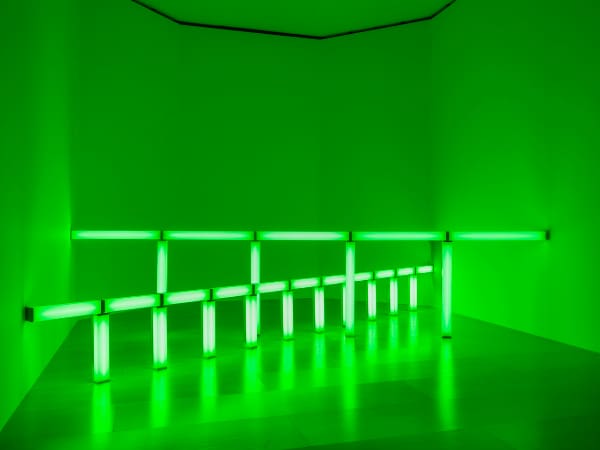
For more than thirty years, Dan Flavin (b. 1933, New York; d. 1996, New York) developed a radical new art form that circumvented the limits imposed by frames, pedestals, and other conventions of display. His embrace of the unadorned fluorescent fixture as an aesthetic object aligned him with a generation of artists whose use of industrial materials, emphasis on elementary forms, and nonhierarchical relationships among component parts became the salient characteristics of Minimalism.
Dan Flavin: Some Light takes its title from Flavin’s first solo show of fluorescent light works, held in 1964 at Kaymar Gallery in New York. Drawing on the Guggenheim’s holdings of Flavin’s work from the Panza Collection, with key loans from Dia Art Foundation in New York, the exhibition traces Flavin’s artistic development from the 1960s through the 1980s, from his early fluorescent constructions in white light to the room-scale chromatic installations of his later career.
In Flavin’s words, “My icons do not raise up the blessed savior in elaborate cathedrals. They are constructed concentrations celebrating barren rooms. They bring a limited light.”