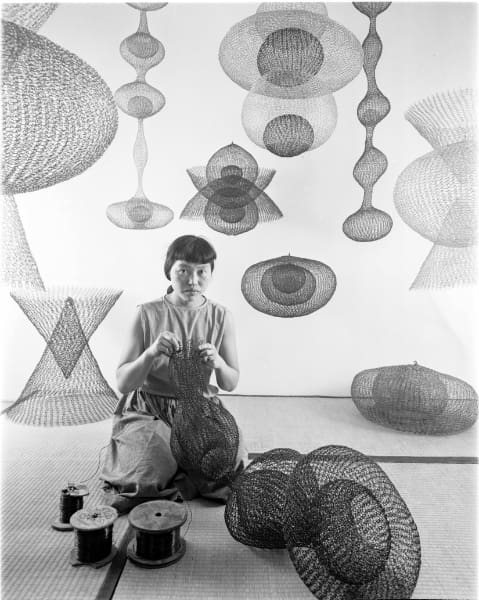
Ruth Asawa (1926-2013) was one of the most distinctive and prolific American artists of the postwar era. Born in California, she was incarcerated with her family in Japanese American internment camps during World War II. In 1946, she enrolled at Black Mountain College in North Carolina, where the experimental environment and mentors such as Josef Albers encouraged her to explore unconventional materials. She began creating her signature suspended looped-wire sculptures—delicate, transparent forms that explore line, repetition, and space.
After moving to San Francisco in 1949, Asawa expanded her practice to include intricate tied-wire works evoking organic structures, as well as bronze casts, paintings, prints, and drawings. By the late 1960s, she had gained recognition in the Bay Area for her public art and advocacy for arts education.
The retrospective is organized in partnership between the San Francisco Museum of Modern Art (SFMOMA) and the Museum of Modern Art, New York (MoMA). This presentation developed in collaboration with the Guggenheim Museum Bilbao offers a comprehensive examination of her innovative career.